
Events
-
-

Behavioral Health Coding: 2025 Update
Participants will leave with an understanding of CMS Documentation Guidelines for Behavioral
Health Integration, understanding risk adjustment and how it affects their practice and patient
care. Participants will also explore nuances about true disease state and claim coding, including how to handle conditions they are not the treating provider of. -
-

Increasing Access to Mental Health and Substance Use Care
The Bowman Family Foundation ("BFF") and its tax-exempt subsidiary, the Mental Health Treatment and Research Institute LLC ("MHTARI"), focus on improving the lives of people with mental health and substance use ("MH/SU") conditions by funding projects, reports, and the development of tools to increase access to MH/SU care. In our session on October 9th, we will describe the range of BFF initiatives undertaken to improve access to timely, affordable MH/SU care.
-
-

Collaborative Care in the Women’s Mental Health Space
Join Dr. Jessica Gaulton, CEO of FamilyWell, as she shares an evidence-based model for integrating mental health into OB/GYN clinical practice including all aspects of a women’s reproductive health journey - from infertility struggles, pregnancy, postpartum, and even menopause. Learn more about who we serve, what we do, and how we do it—plus real-world data, outcomes, and practical strategies to strengthen collaboration across healthcare teams.
-
-

Building Effective Peer Recovery Specialist Teams: What Employers Should Know
This session covers what employers must understand before hiring or expanding peer recovery support specialist positions. Casey will explain how to recruit the right peer beyond lived experience, how to set clear role boundaries that prevent burnout and role drift, and how peer-to-peer supervision protects the integrity of the profession. This is a practical conversation on how to set peers up for success in real settings, not a theoretical discussion.
-
-

Treating Substance Use Disorders in the Collaborative Care Model
Co-occurring substance use disorders and mental health conditions are common in the primary care setting. Join us for this engaging webinar where we will highlight how CoCM can also help PCPs screen for, diagnose, and treat SUDs in primary care.
Learning Objective 1: Review best practices for screening and diagnostic criteria for SUDs
Learning Objective 2: Discuss evidence-based treatment options for people living with substance use disorders (SUDs)
Learning Objective 3: Discuss how integrated behavioral health models, such as the Collaborative Care Model ( CoCM), can address co-occurring mental health disorders and SUDs in the primary care setting.
-
-

Life Hacks: Stress Management for Healthcare Providers
This interactive, lively workshop teaches participants how to first recognize stress and then provides practical, easy-to-use tools that are proven to reduce stress and increase energy to get through the busiest of days. By the end of this training, all participants will:
- Walk away with their own toolkit of practical stress management strategies that can be used in any situation
- Gain a deeper understanding of stress and our stress responses.
- Immediately notice the difference in stress levels by practicing 4-6 stress management tools via live demonstration -
-
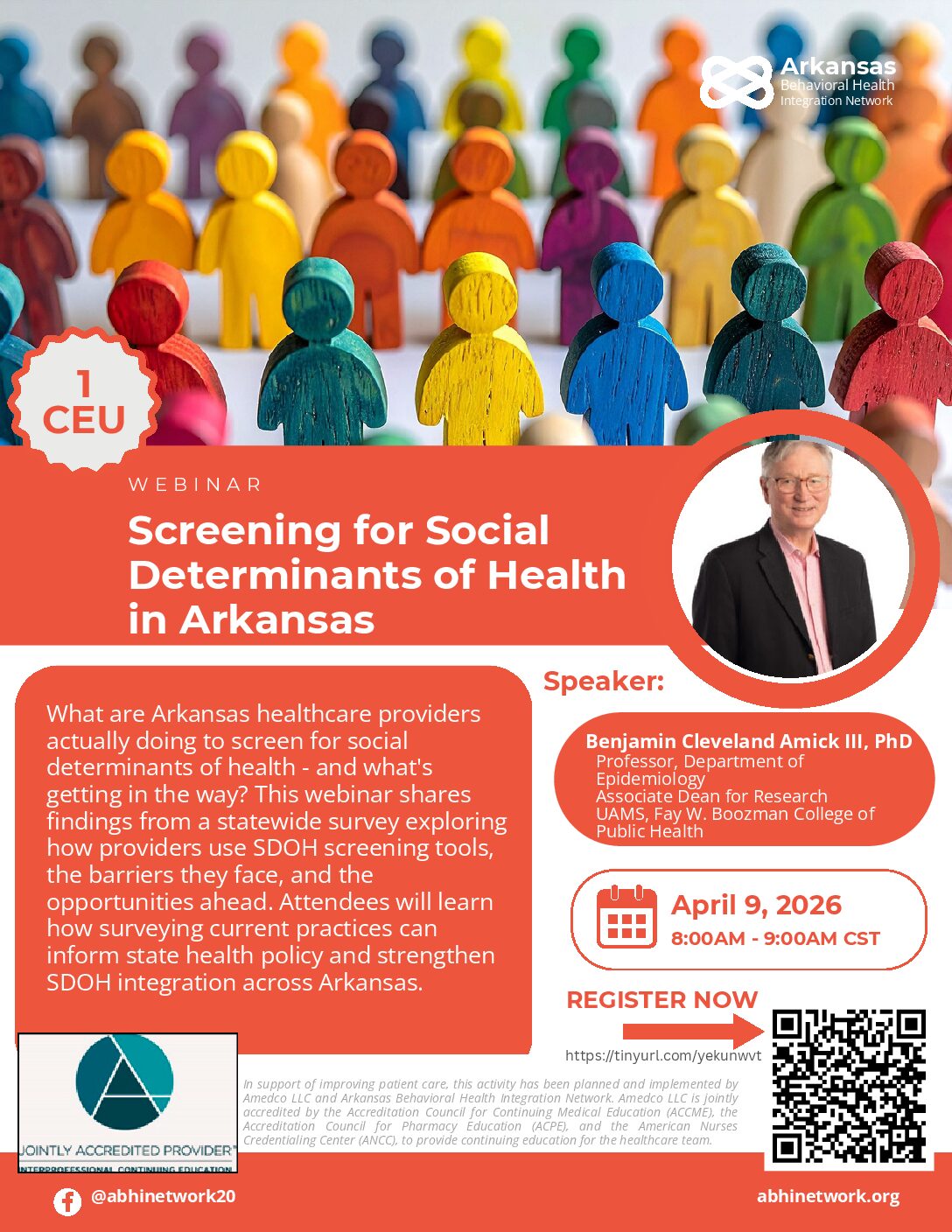
Screening for Social Determinants of Health in Arkansas
What are Arkansas healthcare providers actually doing to screen for social determinants of health - and what's getting in the way? This webinar shares findings from a statewide survey exploring how providers use SDOH screening tools, the barriers they face, and the opportunities ahead. Attendees will learn how surveying current practices can inform state health policy and strengthen SDOH integration across Arkansas.
-

2026 BHI Conference
FeaturedChenal Event Venue 21 Rahling Circle, Arkansas, United StatesJoin us for the 4th Annual Arkansas Behavioral Health Integration Conference, the state’s premier event dedicated to advancing whole-person care. Each year, 250–300 professionals across primary care, behavioral health, hospitals, and community organizations come together to strengthen integrated care efforts statewide. 2026 will highlight collaboration as the foundation for improved access and outcomes and offer expanded networking opportunities, continuing education credits (CE), and national and state experts providing practical, evidence-based strategies to enhance and/or refine quality whole-health care (fulfillment, application, execution).
$25.00 – $75.00